For fleet operators
Your connected estate on one screen.
WattStack Control Room brings all your deployed energy devices onto one screen. Heat pumps, hot water cylinders, batteries and EV chargers, from any manufacturer, across every home you manage. Nothing needs to be replaced or ripped out.
See it working
The single pane of glass.
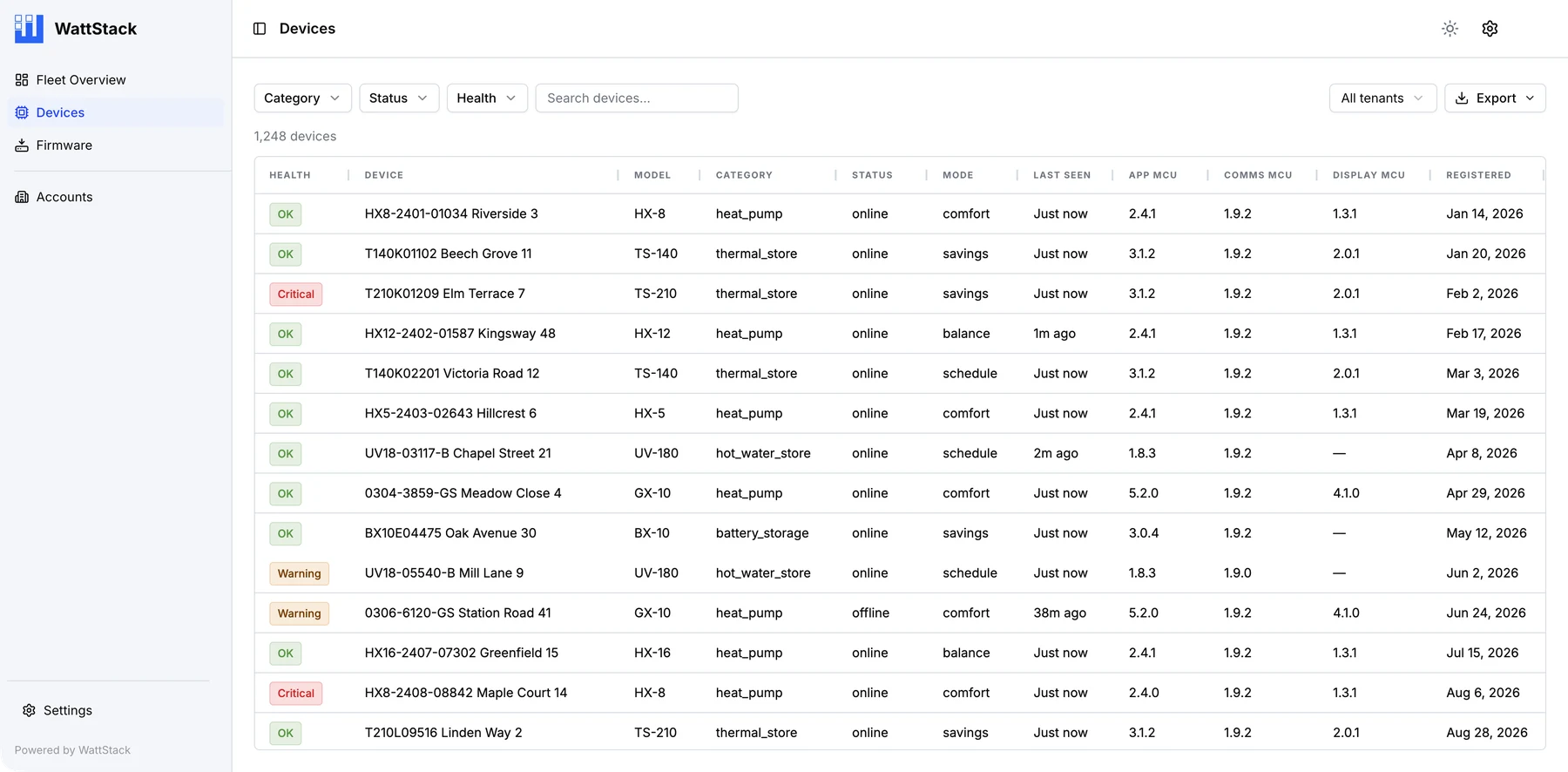
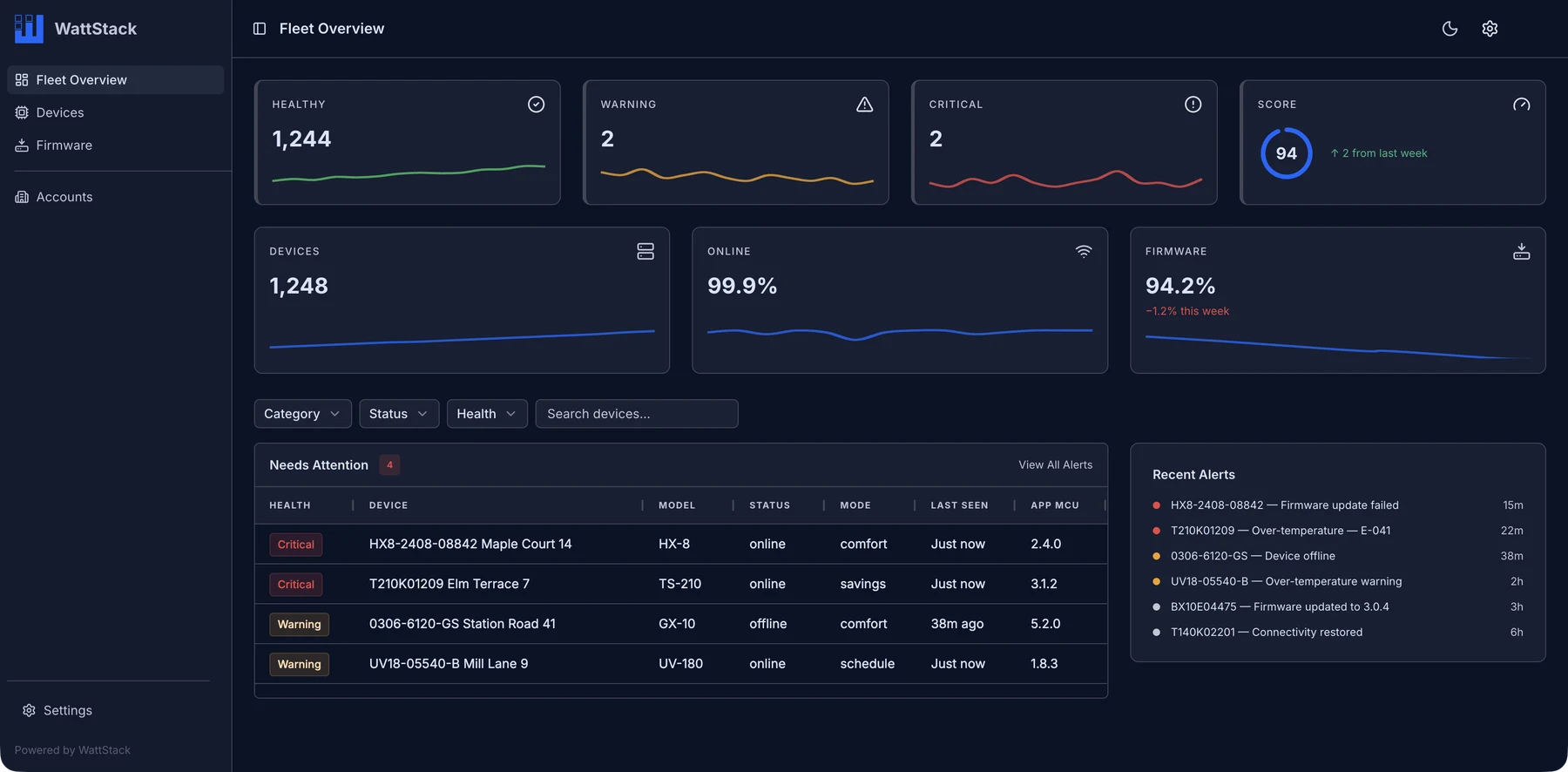
Control Room is where your day runs. What is healthy, what needs attention, and what you can fix remotely.
What Control Room gives you
A single management view, across manufacturers and device types.
One view of your estate
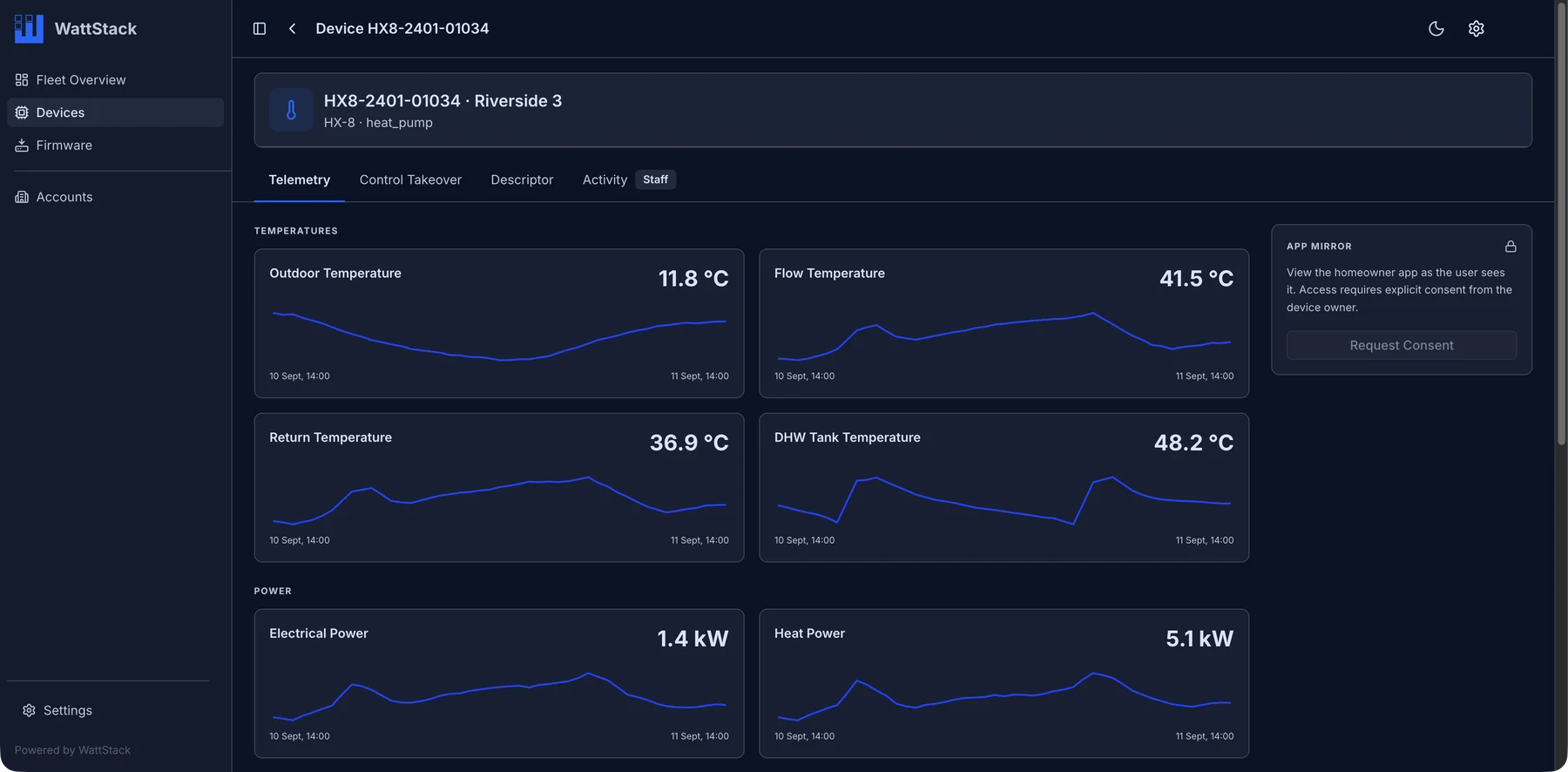
Control Room shows every WattStack-connected device across your sites, no matter which manufacturer made it, with its health, status and diagnostics in one place.
Fewer visits to site
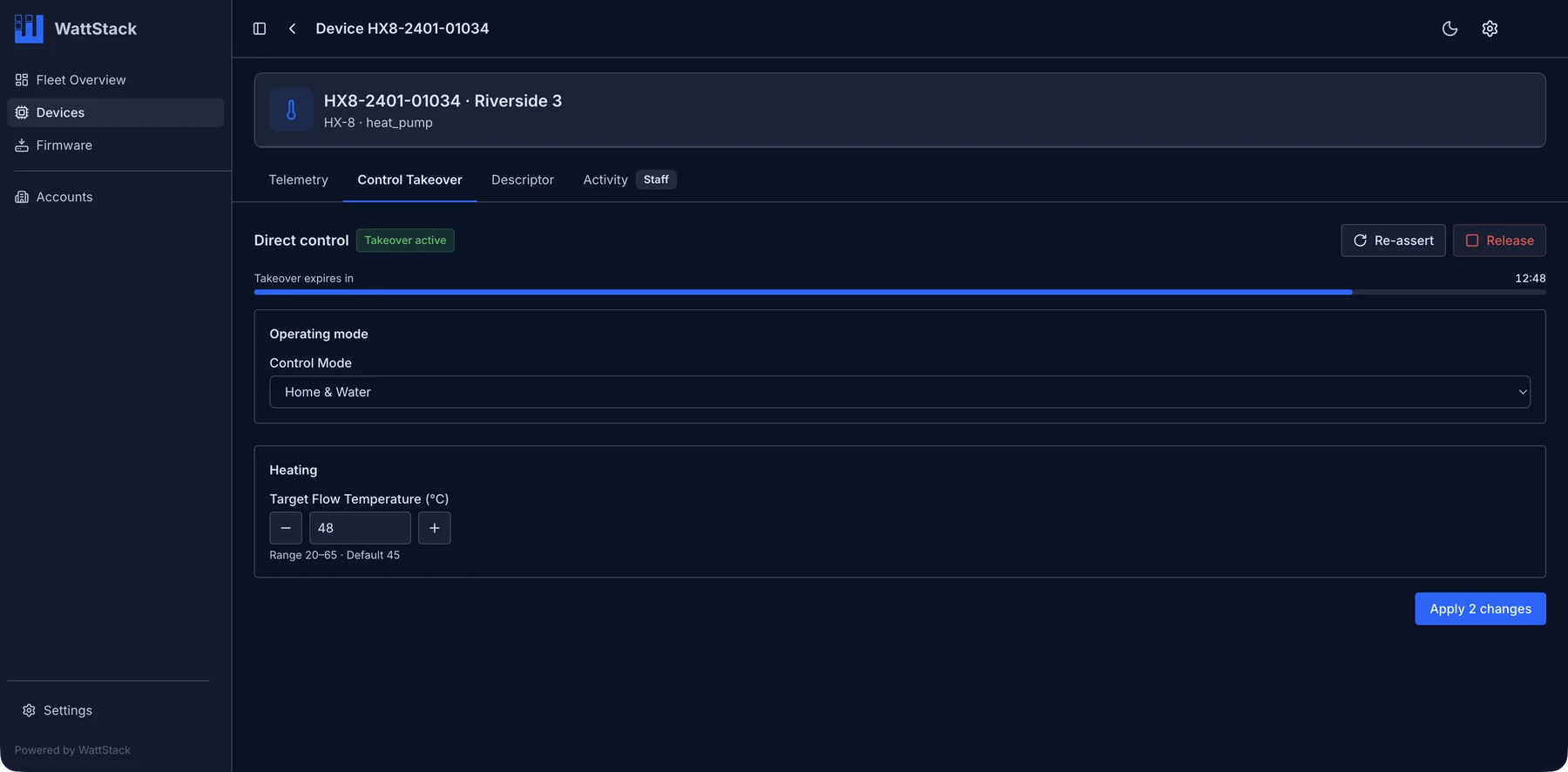
You can see what is actually wrong with a device from your desk, in detail, and where viable take control and fix it remotely. Software updates to devices go out on your schedule, not ours. For an organisation that has to arrange access and give notice before anyone can attend, every avoided visit is time, cost and goodwill saved.
No lock-in
If you leave WattStack, your estate keeps working. Your data is yours to take with you, and your devices stay reachable over open protocols rather than only through us. That includes any Hub fitted in a home. A Hub is a WattStack Edge with different connections, and builds on the same open standards, so it is not a box that only works with us.
Security enforced in hardware
Devices in homes you are responsible for sit behind a boundary that is a physical property of the module, not a promise made by software. The processor that runs the device has no wire to the radio, so whatever happens on the network side, the controls that keep a home running are out of its reach.
Comfort choices for the resident
The device’s day-to-day controls are held on the device itself, not in the cloud. Whether a resident can override a schedule, through the app or a local control, is your choice and yours to configure. When your team takes control to diagnose or fix something, it is a time-limited session. When it ends, control goes back to how it was before.
Ready to save, ready to earn
Connected devices can follow the tariff on each home, heating, charging or storing when electricity is cheapest. If you opt in, they can also earn by helping out when the grid asks, generating an extra return on the equipment.
Retrofit viable
Enhance your existing devices, without replacing them.
Many estates have already heavily invested in energy devices. The WattStack Hub, a small unit fitted alongside the equipment you already have, brings it onto the platform over protocols it already speaks, so a device does not need WattStack inside it from the factory to benefit. When you install new equipment, an Edge can be built in at the factory or fitted as a retrofit, and both routes sit together in the same estate view.
See the four ways to fit the Edge →Mixed device types across many homes, reaching one screen through the Edge in each of them.
How a rollout runs
Onboard in tranches, as you are ready.
-
Survey
We work with you to check the types of device in your estate, how each one can be connected, and which of them we connect to today and which we would build support for first.
-
Pilot
A time-boxed pilot on a small, representative sample proves we can connect to your devices, bring them into Control Room and run them day to day, before you commit the rest of the estate.
-
Tranches
Rollout for the rest of the estate follows an agreed plan, grouped by device type or location, each with dates and arranged access to homes.
-
Operate
Control Room becomes your day-to-day tool, and we keep the platform current with the regulations that govern controlling devices in homes.
What it will cost you
Hardware and Control Room one-offs, and a platform fee.
- Hardware, Hubs for your existing devices or Edge for new ones
- Control Room, one-off activations after a free allowance
- Platform fee, per device
With Control Room as your management interface, nothing extra is needed to run your fleet. A pilot costs you nothing from us: the hardware is on loan and no fees apply until you move forward.
See pricing →Before you commit
What a pilot asks of you.
Understand the scoping before you take it for approval.
- Homes
- A small sample, usually one device type on a single scheme or block, that you propose. It grows in steps from there, as far and as fast as suits you.
- Access and installation
- One visit per home where a Hub is needed, which for most existing estates is every home, carried out by your installer or contractor. We tell your engineer exactly what to fit and how to check each unit as it comes online. Devices with WattStack already inside need no visit.
- Your team
- A named contact who works with us on scheduling and resident notice, and then runs the pilot fleet in Control Room.
Start with one device type.
Run a low-risk, time-boxed pilot on a small sample, with success measures you set. Then grow it in steps, and decide for yourself how far it earns its place across the wider fleet.